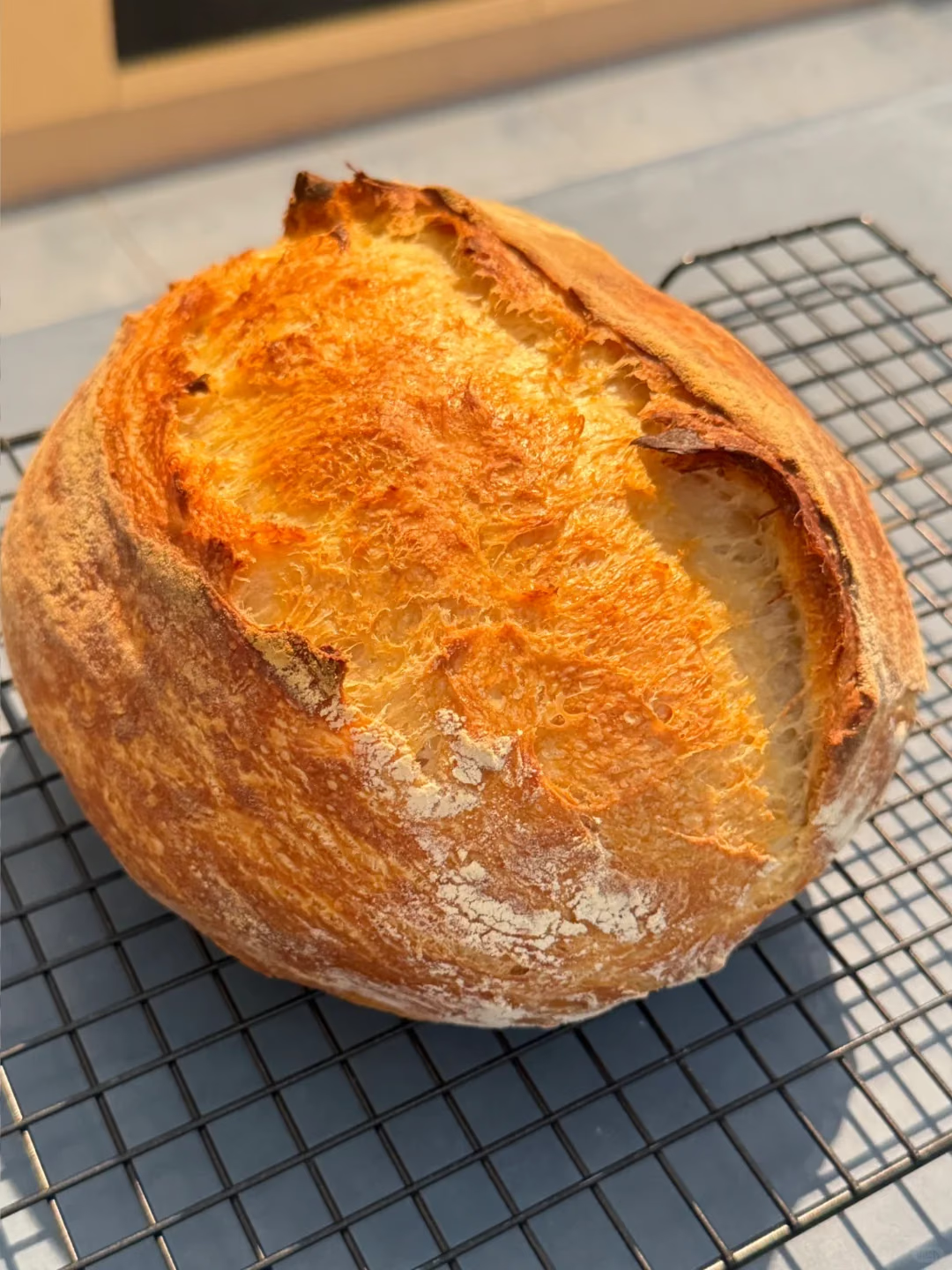
A country loaf here means a lean, free-standing bread of flour, water, salt and ripe starter, baked as a boule or bâtard. The worked example below is the same 860 g ledger as the dough calculator: 70% hydration and 10% prefermented flour. It is an illustrative formula for planning, not a record of a Sourdough Bench test bake.
- Count flour and water inside the starter before you call a dough 70% hydration.
- 20% starter by weight is not the same as 20% prefermented flour.
- Keep this formula still while you learn bulk, shaping and the oven.
What this country loaf is, and what it is not
Searchers asking for a basic sourdough country loaf usually want a crusty everyday bread, not brioche, focaccia or a pan sandwich loaf. In bakery language that loaf is often a boule or a bâtard made from a lean dough: wheat flour, water, salt and a ripe starter or levain. The shape is a choice you make at the bench. The formula is the set of weights you mix.
This guide gives you one complete ledger you can type into the dough calculator and one sequence for mixing, bulk, shaping and baking. It does not claim that 70% hydration suits every flour, or that a clock time will finish fermentation. The Perfect Loaf’s beginner sourdough and King Arthur’s naturally leavened loaf are full published methods if you want a publisher’s step-by-step beside this explanation. Use one method at a time.
A worked 860 g country-loaf ledger
Start from total flour, not from the flour you pour into the bowl. For this example, total flour is 500 g. Hydration is 70%, so total water is 350 g. Salt is 2% of total flour, so 10 g. Prefermented flour is 10% of total flour, so 50 g of the 500 g already sits inside the starter. A starter kept at 100% hydration is equal parts flour and water by weight, so that 50 g of flour arrives with 50 g of water: 100 g of starter.
The amounts you weigh are therefore 450 g flour, 300 g water, 100 g starter and 10 g salt. Together they make 860 g of dough. The starter’s 50 g of water is already inside the 350 g total, so you do not add another 50 g on top. This is the same arithmetic the dough calculator uses for its starting formula. If your scale, flour bag or room is different, keep the percentages and change one thing later, not all four weights at once.
| What you write down | This example | What it includes |
|---|---|---|
| Total flour | 500 g | Flour in the bowl plus flour in the starter |
| Total water | 350 g | Water in the bowl plus water in the starter |
| Starter you weigh | 100 g | 50 g flour and 50 g water when the starter is 100% hydration |
| Salt | 10 g | 2% of total flour, added by weight |
| Dough before baking | 860 g | Not the weight of the cooled loaf |
Do not mix up starter percentage and prefermented flour
Bakers use both phrases, and they are not interchangeable. In the ledger above, starter weight is 100 g and total flour is 500 g, so starter mass is 20% of total flour. Prefermented flour is only the flour inside that starter, 50 g, which is 10% of total flour. A recipe that says “20% starter” might mean either number. Read the formula before you type it into a calculator.
If you instead want 20% prefermented flour at 100% starter hydration, the starter weight doubles to 200 g and the flour and water you add both drop by 50 g so the totals stay 500 g flour and 350 g water. That is a different dough even though someone might still call it 70%. The reading-a-formula guide walks through this trap in more detail. Resolve it on paper before you mix.
Choose a flour you can handle twice
For a first country loaf, a strong white bread flour, or a blend that is mostly white with a small share of whole wheat, is easier to read than a high-rye dough. Whole-wheat and rye flours absorb water differently and often ferment faster. If you change the flour, you have changed the experiment. The 70% figure above is a starting description for a typical bread flour, not a target you must hit with a thirsty whole-grain blend.
Weigh flour from the bag you will actually use. Spooned cups vary, and a new bag can feel stiffer or softer at the same hydration. Write the brand and type in the bake log next to the 450 g. If the dough feels impossibly stiff or soupy compared with the recipe you are learning, stop and check that the starter was included in the hydration, then adjust water only on the next bake.
Mix, fold and read bulk before you watch the clock
Mix until you cannot see dry flour. A short rest, then salt, is one common order; mixing everything together is another. Follow one sequence. Salt at 2% is part of this formula’s flavor and dough strength, not an optional sprinkle. After the dough is cohesive, use stretch-and-folds or coil folds during bulk if the method you are following calls for them. Folds build strength. They are not a separate fermentation you add on top of bulk.
Mark the dough’s starting height in a straight-sided container. For this style of loaf you are looking for expansion, a domed and aerated surface, and a dough that feels stronger than it did at the mix. King Arthur’s bulk-fermentation notes and our bulk-signs guide both say the same thing: time is a record, not the finish line. A 78°F dough and a 70°F dough will not match the same clock. Write the dough temperature after mixing.
Shape a boule or a bâtard from the same dough
Divide only if you planned more than one loaf. A single 860 g dough fits many home Dutch ovens as one loaf; if your pot is small, scale the formula down with the calculator rather than cramming dough into a vessel that cannot hold it. Preshape, rest, then shape a round boule or an oval bâtard. The formula does not change. The basket, the score and the way the loaf springs in the oven do.
Place the seam so it matches your baking plan. A seam-up basket is scored on the top after you turn it out; a seam-down loaf may open along the seam. Cold proofing overnight is optional and belongs to the overnight schedule, not to this formula by default. If you bake the same day, give the shaped loaf a final proof until it is airy but still has some strength, then bake. Do not use a single finger poke as the only decision.
Bake with heat and steam, then cool before you judge
Preheat the vessel your recipe expects. A covered Dutch oven traps steam for the first part of the bake; an open stone needs another steam plan. Score with a sharp blade just before loading if the loaf was seam-side down in the basket. Bake until the crust is deeply colored and the loaf sounds settled, then cool it on a rack until the interior finishes setting. Slicing early makes a gummy line on the knife even when fermentation was fine.
Judge this loaf against a country loaf, not against a sandwich slice. An open but irregular crumb can be exactly what you wanted. A dense center, a loaf that spread into a pancake, or a crust that never browned are different problems with different guides. Photograph the cooled cross-section next to the 860 g ledger so the next change has a before.
Change one variable on the next bake
If the loaf was edible and the process was clear, repeat the same weights before you chase a more open crumb. The useful second bake changes one thing: dough temperature, the amount of whole wheat, or the length of the final proof. Write the question at the top of the bake log. A higher hydration, a new flour and a longer cold proof on the same day would leave you with three explanations.
If the dough never rose, do not keep adding water to this formula. Go to the not-rising guide and separate starter activity from bulk. If the crumb is tight and the crust burst in a wild ear, read underproofed loaf next. If the loaf spread flat, read spreading and overproofing before you blame the 70% number. The formula is a reference. The notes tell you which reference you actually baked.
FAQ
What is a basic sourdough country loaf?
A lean free-standing loaf of flour, water, salt and ripe starter, usually shaped as a boule or bâtard. It is not a pan sandwich bread and it does not require milk, butter or commercial yeast.
What hydration should a beginner country loaf use?
A clear starting point is 70% total hydration, counting water in the starter, with bread flour you can handle. Change hydration only after you have baked and logged that formula once.
How much starter is in the 860 g example?
100 g of starter at 100% hydration. That is 50 g flour and 50 g water, or 10% prefermented flour. It is not the same as a recipe that means 20% prefermented flour.
Can I bake this formula the same day?
Yes if your starter is already active and the dough is warm enough to move through bulk and a final proof before you need the oven. Use the same-day schedule, and switch to an overnight cold proof when the clock does not fit.
Is this a tested Sourdough Bench recipe?
No. The weights are an illustrative baker’s-percentage ledger that matches the dough calculator. Fermentation and baking steps should follow a complete published method and your own notes.
Sources & further reading
This guide combines published references with our own explanations and decision aids. Numerical examples are illustrative; they are not records of Sourdough Bench test bakes.
Put it into practice.
Keep the recipe, observations and next change together in your downloadable bake log. For a symptom-led starting point, use the loaf troubleshooting guide.
Keep reading
- How to Read a Sourdough Formula Before You Mix
- Sourdough Hydration Explained: Percentages & Examples
- Shape a sourdough boule or bâtard with better control
- Sourdough Sandwich Loaf: Pan Formula, Hydration and Slice Texture
- Lean Sourdough Loaves: Simple Flour-Water-Salt Breads
- What to Bake Each Season with Your Sourdough Starter
- Bulk Fermentation Signs: How to Tell When Sourdough Bulk Is Done