Two hours, barely a bubble? Start with three simple checks.
Measure the dough. A cool dough can take longer.
Was it included, and was it active?
Compare with your last check, not just the timer.
Keep this by the bowl.
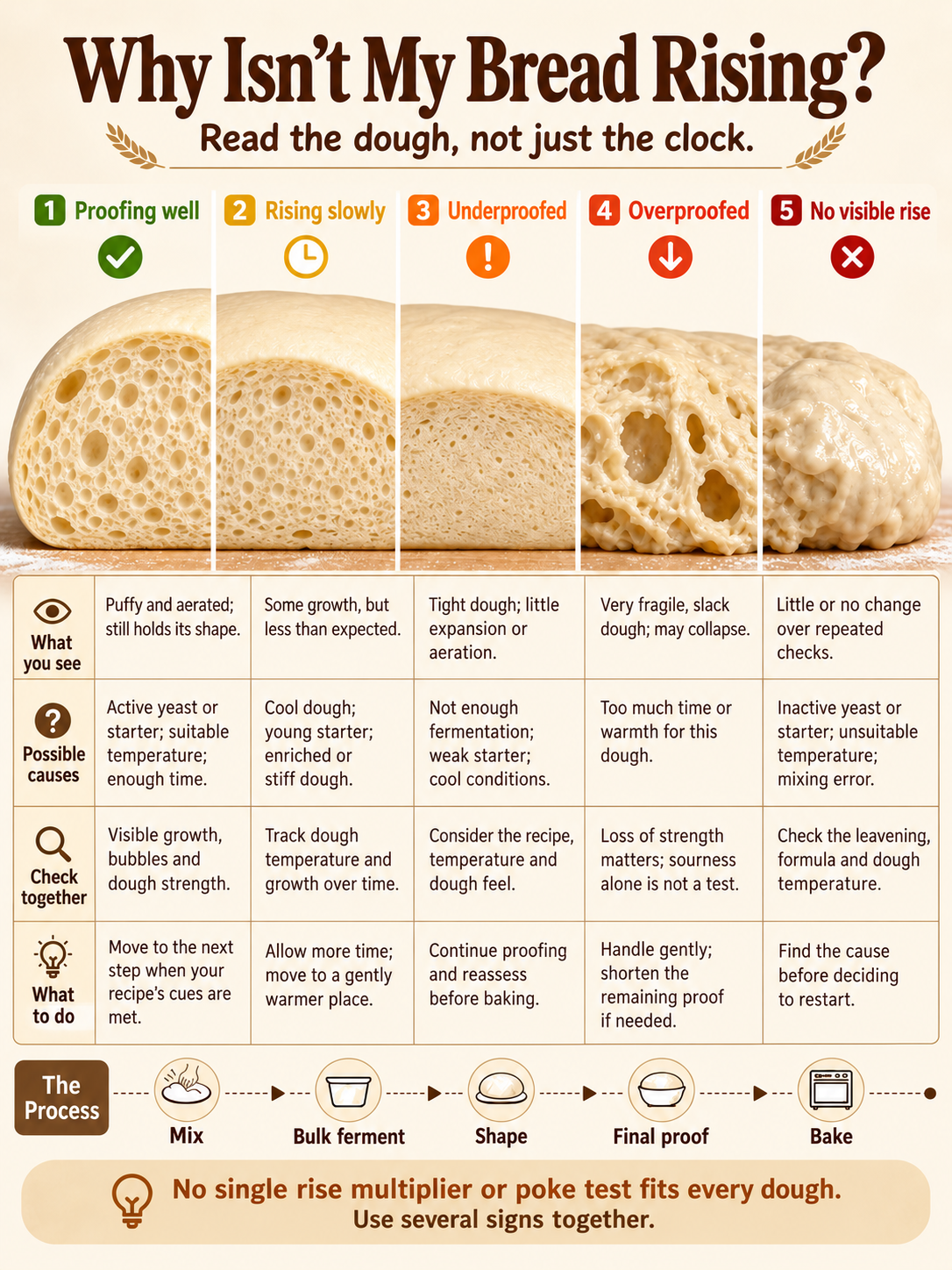
Which looks familiar?
01Developing wellAiry and gaining strength? Follow your recipe’s next step.
- What you may notice
- The dough is becoming more aerated and expanded, with strength and elasticity appropriate to the recipe.
- What to check
- Compare its progress with the recipe’s cues for the current stage: bulk fermentation and final proof have different jobs.
- Your next step
- Move on when the combined signs fit your method. A dramatic rise is not the only sign to look for.
02Slow, but still movingA few bubbles, a little growth? Give it time and check the warmth.
- What you may notice
- The change is modest, but bubbles or a little expansion show progress across successive checks.
- What to check
- Measure the dough temperature and review the starter or yeast used. A cooler dough can take longer.
- Your next step
- Keep it covered, allow more time within the recipe’s conditions, and observe again. Use gentle, controlled warmth if needed; avoid a hot spot.
03Not ready yetStill tight and heavy? Reassess before moving on.
- What you may notice
- The dough is still tight or heavy, with little development compared with the recipe’s expected condition.
- What to check
- Ask whether you are about to end a stage too early. At a suitable final-proof stage, a fast rebound after a gentle poke can support that impression.
- Your next step
- Give it more time and reassess its temperature and activity. Do not advance solely because a timer has finished.
04Possibly gone too farRose, then weakened? Handle gently and avoid another long wait.
- What you may notice
- The dough has risen and then weakened, spreads more than before, or deflates easily during handling.
- What to check
- Read that change alongside the time, temperature and dough strength. Large holes or a sour aroma alone do not diagnose overproofing.
- Your next step
- Avoid adding another long rest just to follow the original schedule. Handle gently and follow your recipe’s advice for the stage you have reached.
05No observable riseNothing changing? Check the starter or yeast, formula and temperature.
- What you may notice
- The dough shows little or no change across repeated, comparable checks.
- What to check
- Review whether the levain or yeast was included, its activity, the dough temperature, the weighed formula and whether your container makes changes visible.
- Your next step
- Investigate the cause before starting another batch. More waiting cannot replace omitted leavening or an inactive culture.
A sour aroma or a large hole alone cannot diagnose overproofing. Look at the whole process.
Make your next check more usefulA few tips for reading the dough
Keep a reference point.
Mark the starting level, note the mixing time and dough temperature, and take a photo. Compare similar views; a fold changes the dough’s shape and apparent height.
Read several signs together.
Look for expansion, aeration and changing strength. “Slow” describes the pace; “underproofed” means the dough has not developed enough for the stage. They can overlap. There is no one rise multiple that suits every dough.
Use gentle, measured warmth.
Measure the dough rather than guessing from the room. Compare with the recipe’s conditions and avoid moving the bowl between several unmeasured hot spots.
Remember the starter.
Check when it was fed and whether it rose reliably before mixing. An immature or sluggish starter can change the timetable.
Treat a poke as one clue.
A gentle poke can help with some shaped wheat doughs during the final proof. Cold, very wet or different-flour doughs respond differently. Read its response alongside the other signs.
A sour aroma is normal in sourdough, and an open crumb can be intentional. “No observable rise” describes what you can see; it does not prove that every microorganism is inactive.
Sources & further reading
- How to read bulk fermentation signs
- Sourdough not rising · Find your loaf’s symptom
- King Arthur Baking: Bulk fermentation
- King Arthur Baking: Desired dough temperature
- King Arthur Baking: Starter not rising
- The Perfect Loaf: How to use the dough poke test
- King Arthur Baking: How to produce an open crumb
- King Arthur Baking: Has your dough risen enough?
Adapted from contributed baking notes. Image sources. Our editorial approach.