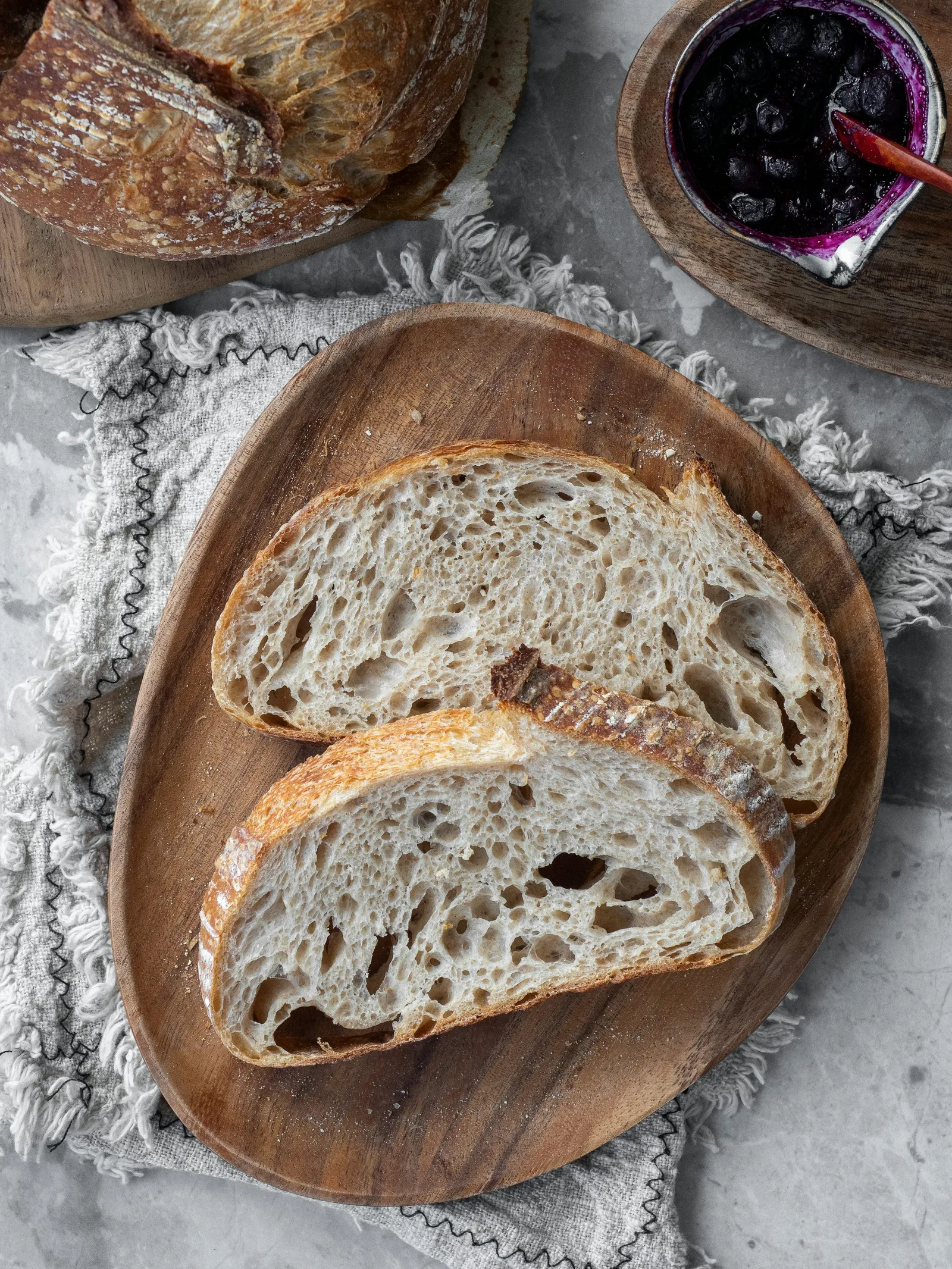
Before mixing, identify the flour basis, starter hydration, prefermented flour and intended batch weight. Translate ambiguous percentages into grams.
- Check whether starter weight or starter flour is being described.
- Distinguish a levain build from the final dough.
- Write a complete ingredient ledger before scaling.
Read composition and method separately
A sourdough recipe usually combines an ingredient plan with a sequence of actions. The formula describes what enters the dough and in what proportions. The method describes how those ingredients are mixed, developed, fermented, shaped, and baked. Reading both is necessary, but separating them first makes missing information easier to spot.
Begin by identifying the finished dough’s flour and water totals, the amount and hydration of starter, salt, and any additions. Then read the method for ingredients introduced later or prepared in separate stages. King Arthur Baking’s baker’s percentage and hydration references provide the conventions used here. The sample formulas in this guide are independent examples intended to teach recipe accounting, not complete tested bread recipes.
Identify what the ingredient list represents
An ingredient list may show everything in the final dough, or it may show only the fresh additions alongside a separate starter amount. Those presentations can describe the same bread. A list containing 500 g total flour, 360 g total water, and 10 g salt is a composition statement. A list containing 450 g fresh flour, 310 g fresh water, 100 g starter at 100% hydration, and 10 g salt is a mixing statement.
The second list adds up to the first because the starter contributes 50 g flour and 50 g water. Both describe 870 g mixed dough at 72% hydration and 2% salt. Before calculating anything, label the flour and water as total or fresh. Many apparent disagreements between recipes begin with those two words being left unstated.
Find the starter’s composition
A line that says 100 g starter is insufficient for an exact hydration calculation unless the starter’s flour-water ratio is known. At 100% hydration, that portion contains 50 g flour and 50 g water. At 60%, it contains 62.5 g flour and 37.5 g water. The same mass can therefore change both the numerator and denominator of dough hydration.
Look for the starter maintenance instructions, levain build, or a note explicitly naming hydration. If the recipe gives only volume or texture, record the uncertainty instead of guessing silently. You may choose a stated assumption for planning, but label the calculated result accordingly. A recipe audit should reveal missing information, not conceal it beneath a percentage displayed to two decimal places.
Trace a levain build through to the dough
Suppose a recipe builds levain with 20 g seed starter at 100% hydration, 90 g flour, and 90 g water. The build weighs 200 g and contains 100 g flour plus 100 g water. If the final dough uses only 100 g levain, only 50 g flour and 50 g water from that build enter the bread.
The unused 100 g may be retained or used elsewhere, but it does not belong in the loaf’s totals. Add the used levain components to the fresh dough ingredients, not every ingredient purchased or mixed during the preparation. This distinction is especially important when a build intentionally leaves a maintenance reserve. Starter preparation yield and bread dough yield are related records, but they are different quantities.
Watch for ingredients repeated across stages
A recipe may describe an initial flour-water rest, a later starter addition, and a final salt-and-water mix. Each amount should be counted once. If the ingredient list says 360 g total water, with 30 g reserved for later, the 30 g is part of the 360 g rather than an extra amount on top.
The same issue appears with instructions such as all the levain or all the initial dough. These refer to mixtures already created, not new flour and water. A useful audit writes each fresh ingredient addition on one line and each transfer between stages on another. When a mixture transfers unchanged into the next bowl, its mass moves forward; it does not multiply simply because it receives a new stage name.
Reconstruct the total formula
For the recurring mixing list, write fresh flour 450 g and starter flour 50 g, producing 500 g total flour. Write fresh water 310 g and starter water 50 g, producing 360 g total water. Salt is 10 g. Dividing each ingredient total by 500 g gives flour 100%, water 72%, and salt 2%.
The starter contains 50 g prefermented flour, so prefermented flour is 10% of total flour. Whole starter mass is 100 g, or 20% of total flour. Preserve both numbers with their labels if you want to compare the recipe with one that reports inoculation differently. Calling either simply starter percentage without a definition leaves an ambiguity that can change how another baker reproduces the formula.
| Quantity | Calculation | Result |
|---|---|---|
| Total flour | 450 g fresh + 50 g in starter | 500 g |
| Total water | 310 g fresh + 50 g in starter | 360 g |
| Hydration | 360 ÷ 500 × 100 | 72% |
| Salt | 10 ÷ 500 × 100 | 2% |
| Prefermented flour | 50 ÷ 500 × 100 | 10% |
| Starter mass | 100 ÷ 500 × 100 | 20% |
Compare recipes on the same basis
Imagine another mixing list with 500 g fresh flour, 360 g fresh water, 100 g starter at 100% hydration, and 10 g salt. Someone dividing only the fresh water by fresh flour might call it 72% hydration. Including the starter gives 550 g flour and 410 g water, making the overall hydration approximately 74.55%.
Its salt is about 1.82% of total flour and its prefermented flour about 9.09%. These are not the same proportions as the recurring example, even though both lists might casually carry a 72% label. Normalize the totals before deciding that one recipe behaves differently despite identical hydration. First confirm that the numbers being compared actually describe the same thing.
Count starter flour in the flour blend
Suppose a dough contains 400 g fresh bread flour, 50 g fresh whole wheat flour, and 100 g starter at 100% hydration. If the starter flour is entirely bread flour, total flour is 450 g bread flour plus 50 g whole wheat, so the blend is 90% bread flour and 10% whole wheat.
If the starter flour is entirely whole wheat, totals become 400 g bread flour and 100 g whole wheat, or 80% and 20%. The mixing weights and overall hydration can be identical while the flour blend changes. Record the starter’s flour type when it matters to your comparison. A flour label on the final mix alone does not describe every flour present in sourdough.
Check yield before choosing a container
Add every ingredient that enters the final dough once. The recurring example yields 450 + 310 + 100 + 10 = 870 g mixed dough. If you divide it into two equal pieces, each is theoretically 435 g before handling losses. This calculation does not predict the cooled baked loaf weight.
Compare the expected batch and piece sizes with your mixing equipment, fermentation container, shaping space, and baking vessel. A recipe that fits a bowl may still produce more pieces than can be baked together. Resolving this before mixing is easier than discovering the mismatch after shaping. The ingredient arithmetic establishes the planned quantities; the method and equipment determine whether that plan is practical for your session.
Separate a feeding ratio from dough inoculation
A levain feeding ratio such as 1:3:3 describes seed starter, added flour, and added water in a build, assuming that order is stated. It does not tell you how much of that levain will enter the final dough. A large build may supply several loaves, while a small portion of an equally mature build may supply one.
Dough inoculation therefore needs its own definition, such as prefermented flour divided by total dough flour. Read the build instructions and final dough list together. The feeding ratio helps reconstruct the levain; the used levain quantity helps reconstruct the bread. Neither number should be substituted for the other simply because both involve starter and both are written as ratios or percentages.
Recognize ingredients outside a lean-dough model
A flour-water-starter-salt calculator cannot automatically explain a dough containing milk, eggs, cooked grain, a seed soaker, or wet fruit. These ingredients bring mixtures of water and solids. A recipe may report a conventional hydration figure that counts only explicitly added water, while another may estimate water contained in additional ingredients.
Look for the author’s convention and avoid forcing unlike formulas into the same calculation. If the convention is missing, identify the limit in your notes. For a soaker, record whether all soaking liquid is used or whether some is drained. For oil, remember that its weight belongs in dough yield but not in the plain-water hydration total. Clear boundaries are more valuable than false precision.
Read timing as part of a process
A formula cannot tell you when fermentation is complete. Ingredient ratios interact with starter condition, dough temperature, flour, and the method. Treat the timing in a source recipe as guidance within the conditions described by that source, then read its observable dough cues carefully. Do not convert a 20% starter label into an exact universal deadline.
When changing batch size, retain the formula arithmetic but reassess the practical workflow. King Arthur Baking’s guidance on reducing recipes notes the importance of observing proofing cues rather than relying only on the original listed time. That principle helps keep the calculator’s role honest: it supplies ingredient amounts and relationships, while the recipe method and dough observations guide the process.
Audit instructions that seem contradictory
If a recipe’s ingredient sum disagrees with its stated yield, check for an unused levain portion, a reserve of water, an omitted addition, or rounding. If its claimed hydration differs from your result, check whether starter flour and water were excluded. If starter percentage seems unusually large, identify whether the denominator is fresh flour, total flour, or total dough.
Do not assume every discrepancy is an error. Different conventions can be valid when they are explained. Preserve the source wording in your private notes, write your interpretation beside it, and recalculate from the underlying weights. When crucial information remains missing, it is better to use a complete, clearly documented formula than to invent details and treat the result as a faithful reproduction.
Make a one-page mixing record
Before starting, prepare a record with the source recipe, fresh ingredient weights, starter mass and hydration, total flour and water, salt percentage, prefermented flour percentage, and expected mixed yield. Add separate spaces for actual water used, any substitutions, and the method’s key observations. This keeps the planned formula distinct from what happened during mixing.
Afterward, update the measured facts without rewriting the target as if every step matched it perfectly. A little water held back, a different flour, or an unexpected portion size is useful information. With a clear record, a future adjustment can address one defined variable. Reading a formula well is ultimately the ability to follow every ingredient into the dough and explain which conclusions the numbers do, and do not, support.
Sources & further reading
This guide combines published references with our own explanations and decision aids. Numerical examples are illustrative; they are not records of Sourdough Bench test bakes.
Put it into practice.
Keep the recipe, observations and next change together in your downloadable bake log. For a symptom-led starting point, use the loaf troubleshooting guide.