Homemade Sourdough Pizza Recipe (Home Oven)
A homemade sourdough pizza for a home oven: 70% hydration dough, a cold ferment, and a hot stone, steel, or sheet. Two pies from 500 g flour.
View saved recipes · Saved on this device.
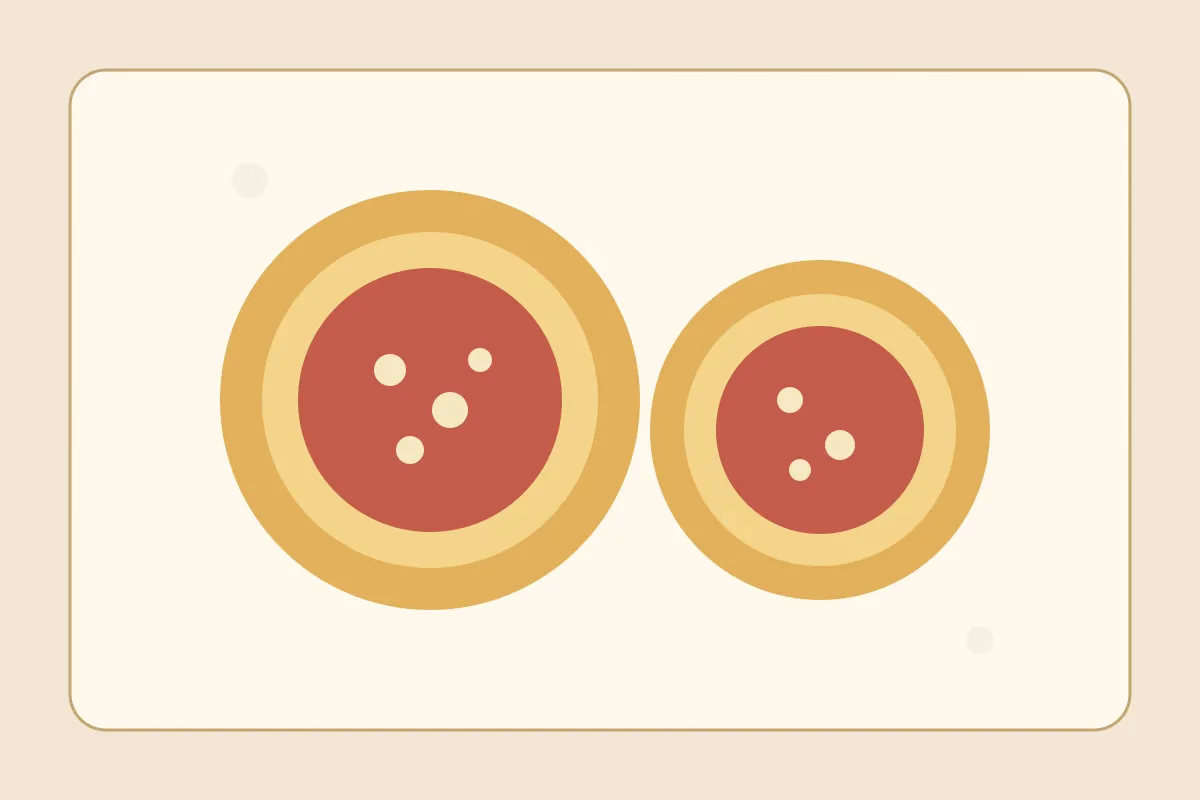
This homemade pizza recipe is sourdough for a home oven: two pies from 500 g total flour at 70% hydration. A 100 g starter at 100% hydration is 50 g flour and 50 g water. You weigh 450 g more flour, 300 g water, 10 g salt, and 15 g olive oil. The dough weighs 875 g.
The card times are hands-on work and the bake. Bulk and a 24 hour cold ferment are extra. Plan bulk with the proofing time calculator if your dough is not near 78°F / 26°C. Scale the flour, water, salt, and starter in the dough calculator, then add the oil on top of that ledger. The closed choice on this page is the pizza formula: these percentages, this home-oven bake. A lean baguette is the French bread recipe. A pan of focaccia is a different dough.
Baker’s percentages for this pizza dough
| Ingredient | Baker’s % | Weight |
|---|---|---|
| Total flour | 100% | 500 g |
| Total water | 70% | 350 g |
| Prefermented flour | 10% | 50 g |
| Salt | 2% | 10 g |
| Olive oil | 3% | 15 g |
| Bread flour to weigh | — | 450 g |
| Water to weigh | — | 300 g |
| Starter at 100% hydration | — | 100 g |
Homemade Sourdough Pizza Recipe (Home Oven)
- Makes
- 2 pizzas
- Prep · estimate
- 40 min
- Cook · estimate
- 18 min
- Total · estimate
- 58 min
Ingredients
- 450 g white bread flour, plus flour for the bench
- 300 g water, cool or at the temperature you calculated
- 100 g ripe sourdough starter at 100% hydration (50 g flour and 50 g water)
- 10 g fine salt
- 15 g olive oil
- 200 g crushed tomatoes
- 4 g fine salt, for the tomatoes
- 140 g low-moisture mozzarella, shredded
Method
Write the pizza formula before you mix
Total flour is 500 g. Total water is 350 g, which is 70% hydration. Salt is 10 g, 2% of total flour. Olive oil is 15 g, 3%. Prefermented flour is 50 g, 10%. The 100 g starter is 50 g of that flour and 50 g of that water, so you weigh 450 g flour and 300 g water. If your starter is not 100% hydration, split it in the dough calculator and change the water you add. Do not also stir in a bowl of discard unless you subtract it with the discard calculator. This is one formula. It is not a focaccia with the oil poured on top.
Mix, then bulk until the dough is aerated
Stir the starter into the water. Add the flour and mix until no dry flour remains. Rest 20 to 30 minutes. Sprinkle on the salt and squeeze it through with the olive oil until the dough is cohesive. Write down the dough temperature. Cover it. During the first 2 hours, give it three stretch-and-folds, about 30 minutes apart. At about 78°F / 26°C, bulk is often near 4 hours and a rise of about 40%. A dough at 72°F / 22°C wants closer to 5 hours. Use the proofing time calculator for that gap, then stop when the dough is aerated and stronger, even if the clock disagrees.
Divide, ball, and cold ferment
Divide the dough into two pieces of about 435 g. Shape each into a smooth ball. Set them in a lightly oiled, covered container so they do not touch and fuse. Refrigerate for about 24 hours, in a fridge near 38°F / 3°C. A window of 12 to 48 hours still works if you watch the dough: tight and dense is too soon to stretch, collapsed and sour is too late. This cold ferment is the flavor and the handling. It is not a same-day loaf schedule.
Warm the dough and heat the surface
Take the balls out 60 to 90 minutes before you stretch them, still covered. Heat the oven to 500°F / 260°C, or 550°F / 290°C if that is your maximum. Put a baking steel, a pizza stone, or a heavy sheet on a rack and preheat it for about 60 minutes. The oven’s ready beep is the air, not the metal. A cold sheet will not brown the bottom. Read the stone-versus-steel guide if you are choosing a surface today.
Stretch, top, and bake
Stir the 4 g salt into the 200 g tomatoes. Flour the bench lightly. Press a ball from the center outward into a round about 11–12 inches / 28–30 cm, leaving a rim. Do not use a rolling pin if you want the rim to puff. Dust a peel or a sheet of parchment. Lay the dough on it. Spread about 100 g of tomatoes, then 70 g of mozzarella, leaving the rim bare. Slide it onto the hot surface. On a preheated steel, bake about 7 to 9 minutes. On a stone, about 8 to 11 minutes. On a sheet, about 10 to 12 minutes. The rim should be spotted and the cheese melted. Rotate once if the back of the oven runs hot. Bake the second pie the same way, after the surface has had 4 or 5 minutes with the door shut. Cool 2 minutes before you slice.
Developed for home use; not kitchen-tested by Sourdough Bench. Times are estimates; use the doneness cues in the steps.
Small things that help
- Seventy percent is a home-oven hydration
- Wetter dough is harder to launch off a peel and easier to tear. Stay at 70% true hydration the first time. If you want a pan pie, oil a sheet and press the dough in it instead of raising the water.
- Steam is for lean loaves
- A Dutch oven or a pan of ice is the wrong environment for these pies. You want a dry, hot surface. The steam guide belongs to French bread and country loaves.
- Leftovers have their own method
- Cool the pies before you cover them. Reheat a slice in a covered skillet for 6 to 10 minutes over medium-low, or follow the reheat guide. A microwave softens the crust you just browned.
Make it your own
- Skip the cheese
- Leave the mozzarella off and bake the tomatoes on the dough. The pie is then free of dairy. It is still this dough. Do not call a cheeseless bake a different hydration.
- Use a little whole wheat
- Replace 50 g of the bread flour with whole wheat flour and keep the water the same on the first try. Read the whole wheat guide before you push the share higher.
- Bake the same day
- Skip the refrigerator if the dough is already extensible after bulk and a 30 minute bench rest. The crust will taste younger. Write that you skipped the cold ferment.
Make ahead & storage
Cool leftover slices before you wrap them. Refrigerate within 2 hours and eat within 3 days, or freeze once cool. Reheat from the refrigerator in a covered skillet, about 6 to 10 minutes over medium-low, or in a 375°F / 190°C oven for 8 to 10 minutes. Thaw frozen slices in the refrigerator before reheating. Throw the pizza away if you see mold. Trimming a spot is not enough.
Dietary notes
Ingredients to check
The dough contains wheat and olive oil. The baked pie also contains mozzarella. Leave the cheese off if you need a dairy-free pizza. The starter should be flour and water only. This page is not an allergy certificate.
Before you start
Is this a homemade pizza recipe for a home oven?
Yes. The oven is set to 500–550°F / 260–290°C, which is a normal home maximum. It is not a wood-fired oven at 800°F or above, and it is not a list of pizza shops.
What hydration is this dough?
70% true hydration. Total water is 350 g and total flour is 500 g, including the flour and water inside the starter. The 15 g olive oil is fat, not water.
Can I put these weights in the dough calculator?
Yes for the flour, water, salt, and starter. Enter about 860 g dough before the oil, 70% hydration, 2% salt, and 10% prefermented flour with a 100% hydration starter. Add the 15 g oil after the calculator’s ledger. Check the grams against this page before you mix.
What if I do not have a pizza stone?
Use a heavy sheet and preheat it for about 60 minutes. The bottom will be lighter than on steel. Bake closer to 10–12 minutes. The stone-versus-steel guide compares the three surfaces.
Why are the card times so short?
Prep and cook on the card are hands-on work and the minutes in the oven. Bulk is often about 4 hours, and the cold ferment is about 24 hours. You will not have pizza in an hour from a cold starter.
Sources & inspiration
- King Arthur Baking: Sourdough pizza
A publisher’s sourdough pizza method. Their formula is not this 500 g ledger. Use one formula at a time.
- King Arthur Baking: Pizza steel vs. stone
Why steel transfers heat faster than a cordierite stone in a home oven.
- King Arthur Baking: Baker’s percentage
The percentage language used to build the 500 g flour ledger.
Recipe writing and serving illustrations are created for Sourdough Bench. Inspiration credits identify the source of an idea; they do not imply that another author tested this recipe. How we publish.


