French Bread Recipes: Lean Sourdough Baguettes
A lean sourdough French bread recipe for two baguettes: flour, water, salt and ripe starter, with steam, scoring and a link to the dough calculator.
View saved recipes · Saved on this device.
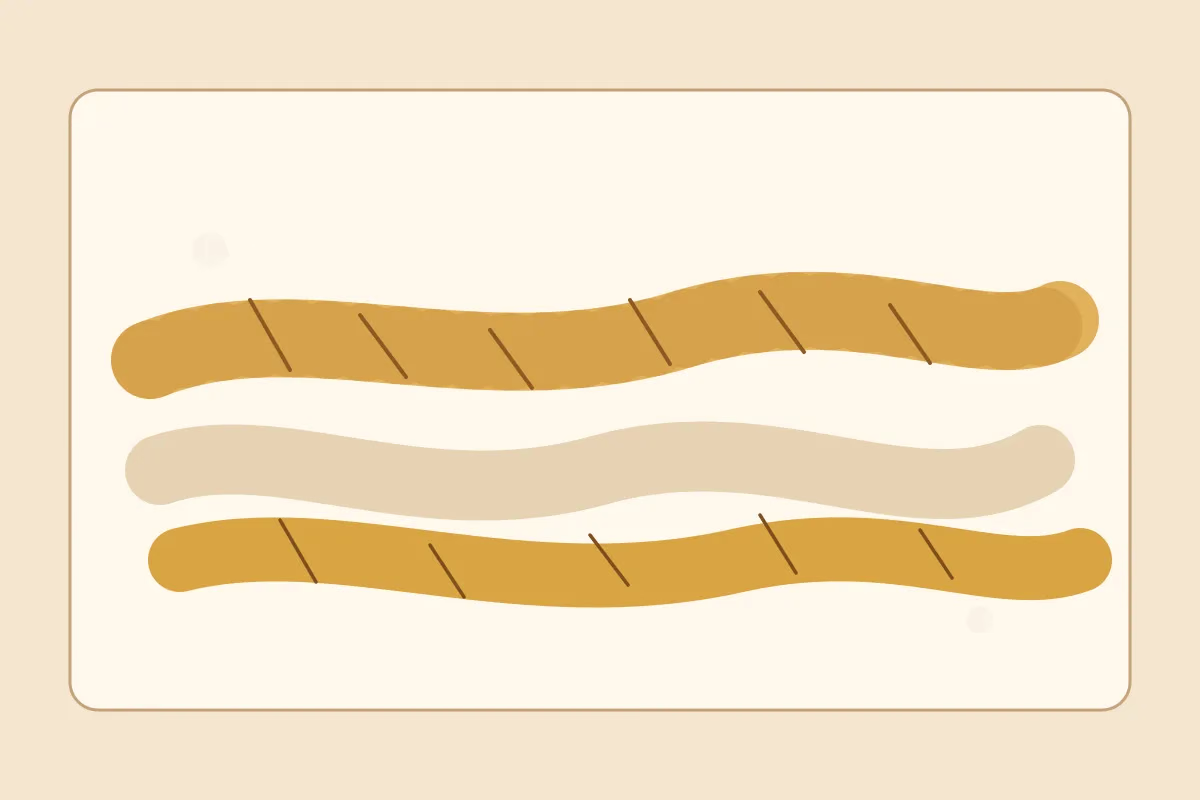
French bread recipes, in the lean tradition, are long loaves of flour, water, salt and a leaven. This version uses ripe sourdough starter instead of commercial yeast. It makes two baguettes from 500 g total flour at about 68% hydration. The weights are a planning formula you can paste into the dough calculator. They are not a record of a Sourdough Bench test bake.
The prep and cook times on the card are hands-on work and the bake. Bulk fermentation and the final proof usually add several hours and are not included in those two numbers. Plan them with the bake planner, and bake the same day only if the starter is already active. For a round country loaf from a similar dough, use the country loaf guide. For part of the flour as whole wheat, use the whole wheat guide and keep this loaf as the white-flour control.
French Bread Recipes: Lean Sourdough Baguettes
- Makes
- 2 baguettes
- Prep · estimate
- 45 min
- Cook · estimate
- 26 min
- Total · estimate
- 71 min
Ingredients
- 450 g white bread flour, plus flour for the bench
- 290 g water, cool or at the temperature you calculated
- 100 g ripe sourdough starter at 100% hydration (50 g flour and 50 g water)
- 10 g fine salt
Method
Confirm the starter and the ledger
Use a starter that has risen on a recent feed and smells tangy, not rotten or moldy. The 100 g starter contributes 50 g flour and 50 g water. Total flour is 500 g. Total water is 340 g. Hydration is 68%. Salt is 2% of total flour. If your starter is not 100% hydration, split it with the dough calculator before you mix and change the water you add so the totals stay the same.
Mix, then add the salt
Stir the starter into the water. Add the flour and mix until no dry flour remains. Rest 20 to 30 minutes, then sprinkle on the salt and squeeze it through until the dough is cohesive. It will feel shaggy and then smoother. Write down the dough temperature. This is the start of bulk, not a separate day.
Fold during bulk
Cover the dough and leave it somewhere steady. During the first half of bulk, give it three or four stretch-and-folds or coil folds, about 30 minutes apart, until it holds a better shape. Bulk is finished when the dough is aerated, expanded and stronger than at the mix, not when a clock rings. A warm kitchen may be ready in roughly 3 to 4 hours. A cool kitchen takes longer. Do not bake it just because the afternoon is ending.
Divide and preshape
Turn the dough out. Divide it into two pieces of about 425 g. Preshape each into a loose log, cover, and rest 15 to 25 minutes until the dough relaxes enough to roll without tearing. A tight, tearing dough wants a little more rest, not more flour pounded in.
Shape two baguettes
On a lightly floured bench, flatten a piece gently into a rectangle. Fold the far long side to the middle, seal, then fold again and seal into a cylinder. Roll it under your palms to about 35–40 cm, tapering the ends, keeping the thickness even. The seam stays underneath. Set the loaves seam-down on a floured linen couche or a thick towel, with a fold of cloth between them so they do not touch and spread into one another.
Proof, then preheat
Cover the loaves and proof until they look fuller and a floured finger pressed at an end springs back slowly. That may be about 45 to 90 minutes at room temperature. Start preheating in time: oven at 240°C / 475°F with a baking stone or steel if you have one, or a heavy sheet, and a pan for steam. If the loaves collapse when you move them, they waited too long. Bake them anyway on the sheet and read the overproofed guide before the next mix.
Score, steam and bake
Transfer the loaves to parchment or a floured peel. With a sharp blade, cut three or four diagonal slashes along the top, overlapping, about 6 mm deep. Slide them into the oven. Steam with a preheated metal pan and a handful of ice, or follow the pot method you trust, and vent the kitchen. Bake about 22 to 26 minutes, until the crust is deep gold and the loaves sound hollow when tapped. Cool on a rack before you slice. A hot crumb looks gummy even when the bake was long enough.
Developed for home use; not kitchen-tested by Sourdough Bench. Times are estimates; use the doneness cues in the steps.
Small things that help
- Keep this as one of your French bread recipes, not a new formula every week
- Repeat these weights once before you change hydration or flour. The dough calculator can scale the same percentages to one baguette or to three. Write the scale factor down.
- Steam is for the opening, not for the whole bake
- The slashes need a moist start so they open. After the crust has set, extra steam only softens it. If you use a pan of ice, leave it in only for the first part of the bake.
- A couche is a support, not a decoration
- The cloth fold keeps a soft baguette from spreading sideways. Without it, use a pan that holds the sides, and expect a slightly wider loaf.
Make it your own
- Bake one longer loaf in a hurry to shape
- Leave the dough in one piece, shape a bâtard, and proof it in a basket. It is the same formula and not a baguette. The country loaf guide covers that shape.
- Swap in a little whole wheat
- Replace 50 to 100 g of the white flour with whole wheat flour and keep the water the same on the first try. Read baking with whole wheat flour before you push the share higher.
- Use a cold final proof
- After shaping, cover the loaves and refrigerate them if you will bake in the morning. They may need a few minutes on the counter before scoring if the skin is very tight. That plan is the overnight schedule, not this same-day card.
Make ahead & storage
Cool the baguettes on a rack until they are no longer warm. Eat them the day they are baked for the crisp crust, or freeze them wrapped once cool. Do not seal them in plastic while hot. If the crust softens, heat them in a hot oven for a few minutes. Throw the loaf away if you see mold. Trimming a spot is not enough.
Dietary notes
Ingredients to check
The loaf contains wheat. It does not contain milk, egg, butter or commercial yeast. Confirm the starter was fed only with flour and water.
Before you start
Is this one of the French bread recipes that uses only sourdough?
Yes. The leaven is ripe starter. There is no commercial yeast in the ingredient list. A publisher’s sourdough baguette that also lists yeast is a different formula.
Why are the times shorter than a real bake day?
The card counts hands-on work and the time in the oven. Bulk and proof are extra and depend on dough temperature. Do not expect bread in 71 minutes from a cold starter.
Can I put these weights in the dough calculator?
Yes. Enter about 850 g dough, 68% hydration, 2% salt and 10% prefermented flour with a 100% hydration starter. Check that the grams match this list before you mix.
What if I do not have a baking stone?
Use a heavy preheated sheet and still score the loaves. The crust will be a little less crisp than on a stone. Steam still helps the slashes open.
Sources & inspiration
- King Arthur Baking: Sourdough baguettes
A publisher’s baguette method. Their formula includes commercial yeast, so the timetable is not this starter-only loaf.
- King Arthur Baking: Baker’s percentage
The percentage language used to build the 500 g flour ledger.
- King Arthur Baking: Baking bread with steam at home
Why the first minutes of the bake stay moist so a score can open.
Recipe writing and serving illustrations are created for Sourdough Bench. Inspiration credits identify the source of an idea; they do not imply that another author tested this recipe. How we publish.


