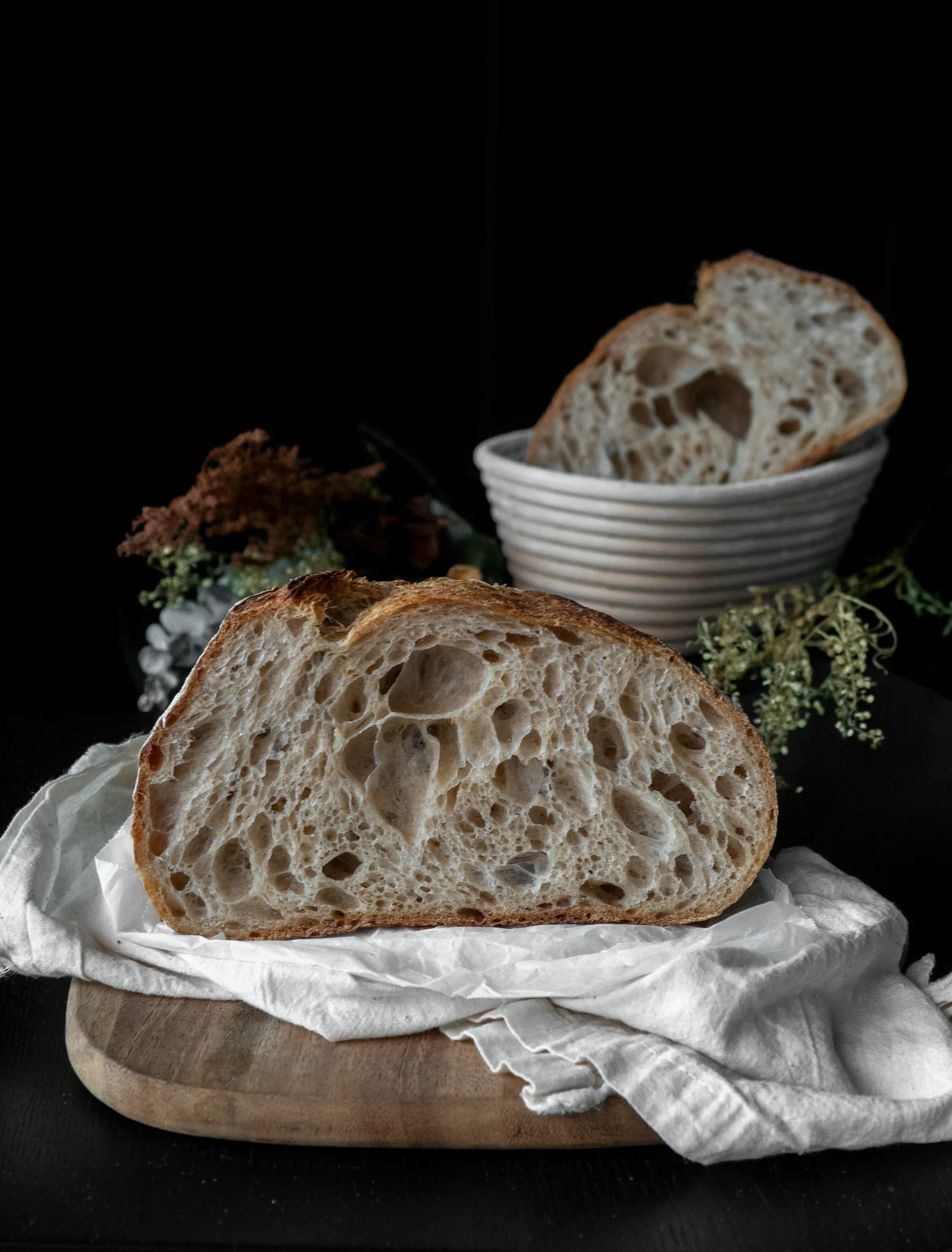
Assess the fully cooled crumb and its pattern before adjusting the formula. Compare starter performance, the bulk endpoint, and handling history; a tight whole-grain crumb and large tunnels surrounded by dense bread are different problems. More water is not an automatic fix.
- Judge density against the bread style and distinguish it from gumminess.
- Treat crumb patterns as clues supported by process notes.
- Keep flour blend, loaf weight, and hydration consistent during a comparison.
- Change the earliest uncertain stage before chasing larger holes.
Decide what dense means in this loaf
Dense sourdough has too little useful expansion for the style you intended, but a close crumb is not automatically defective. A sandwich loaf, a seeded whole-grain bread, and a white country loaf are different targets. Start by describing the eating texture after cooling: pleasantly close and resilient, heavy and rubbery, or a mixture of large tunnels and compressed areas.
The useful goal is a loaf that slices and eats well. Large holes are optional. Before changing the recipe, photograph a central cross-section and one slice closer to an end. Record whether the texture is uniform across them. One attractive hole in a selected slice tells you little about the rest of the loaf, and a photograph cannot measure softness.
Separate density from gumminess
Density describes how much solid bread occupies the slice relative to air spaces. Gumminess describes a sticky or pasty texture. They can occur together, but the first question is whether the cooled slice is heavy yet cleanly cut, or whether it smears and compresses. If it remains sticky, use the gummy crumb guide as well instead of assuming the only problem is fermentation.
Keep your assessment consistent. Use a sharp serrated knife and compare slices of similar thickness after the loaf has cooled. Saw gently rather than flattening the loaf with your supporting hand. A thin slice crushed during cutting can look denser than the same bread cut carefully. Record what happened before the photograph as well as what the photograph seems to show.
Read patterns as clues rather than verdicts
A uniformly tight crumb, a band of compressed bread near the base, and large holes surrounded by dense patches deserve different questions. The Perfect Loaf identifies scattered large holes with tight areas as one possible underproofing pattern. That is supporting evidence, not a laboratory diagnosis. Your notes about dough expansion and shaping are what make the pattern interpretable.
Mark the location of the problem on a simple sketch. Is it everywhere, only below the crust, or concentrated where the dough was rolled together? If the pattern repeats across several central slices, it is more representative than an isolated cavity. Choose a hypothesis that explains both the bread and its handling history, rather than selecting whichever crumb chart looks closest.
| Cooled crumb pattern | Question to ask | Useful next observation |
|---|---|---|
| Uniformly small cells, pleasant texture | Is this the intended bread style? | Compare with the same flour blend and loaf format |
| Large tunnels beside compressed areas | Was fermentation or shaping uneven? | Match the pattern to bulk and shaping notes |
| Localized band or seam | Was dough compressed, stuck, or folded with excess flour? | Review the transfer and shaping sequence |
| Dense and sticky throughout | Is there also a baking or cooling issue? | Use the gummy crumb checks before changing fermentation |
| Lower loaf after a flour substitution | Did the new blend change the comparison? | Restore one documented flour blend |
Verify the starter before changing the flour
Use the starter record from the day of mixing, not its appearance several days later. A culture that was neglected, used straight from a long refrigerator stay, or fed on an unfamiliar schedule introduces uncertainty. Check whether its rise after feeding was observed and whether the batch used the amount and hydration specified by the formula.
You do not need to prove that a starter can rise at a universal speed. You need enough consistency to compare your own bakes. If the starter was an unknown variable, repeat its normal feeding routine and document its behavior before evaluating changes to dough handling. Buying another flour at the same time might produce a nicer loaf while leaving the original question unanswered.
Review how bulk fermentation ended
Look for a recorded reason that bulk fermentation ended: an observed increase, the recipe's described texture, or the arrival of a clock time. If time was the only reason, the endpoint was not actually documented. A recipe schedule is a plan under particular conditions. Your dough may have entered that schedule at a different temperature or with a different starter history.
For the next trial, keep the formula and use a container that makes changes visible. Observe progress between handling steps, when the dough has relaxed enough for comparison. Do not require every recipe to double. The question is whether your dough reached its intended condition before division and shaping, and whether you can recognize and record that condition more clearly next time.
Examine strength and handling together
King Arthur's explanation of folding describes its role in developing a dough network that retains fermentation gas. That makes strength relevant to a dense loaf, but a larger number of folds is not automatically better. Note how the dough responded: whether it gathered into a cohesive mass, resisted further stretching, or tore when you tried to pull it higher.
Use the method appropriate to the recipe and stop forcing a stretch when the dough resists. For a comparison, keep the fold schedule consistent and improve how you describe the result. Counted movements without observations can hide major differences in handling. A gentle complete fold and an aggressive tearing motion should not be recorded as equivalent simply because each was called one fold.
Look for compression introduced during shaping
Reconstruct what happened on the bench. Was the dough repeatedly flattened while you practiced the shape? Did it stick and need to be pulled free? Was a heavy layer of flour folded inside? A loaf that expanded in its container but lost much of that volume during shaping deserves a handling investigation, particularly when the dense region follows a visible seam.
An illustrative next trial could keep the same formula and proofing approach while using one deliberate shaping sequence. Film that short stage if it helps you review hand pressure and sticking afterward. The purpose is not to avoid all gas release. It is to remove uncontrolled repetition and make the handling comparable, so you can see whether the same localized compression returns.
Make a fair comparison between flours
King Arthur's whole-wheat baguette discussion shows why whole-grain dough should not be judged against an all-white loaf without considering the flour blend. Flour composition changes the baking problem. Record the actual products and amounts rather than the broad word flour. A substitution made because two bags looked similar is still a change worth noting.
Suppose one dough uses 450 g white flour and 50 g whole-wheat flour, while another uses 250 g of each. Both contain 500 g flour, but the whole-wheat share has moved from 10% to 50%. Keeping the water weight identical does not make these a controlled fermentation comparison. Establish a repeatable version of one blend before judging whether a timing adjustment improved it.
Audit water without chasing a larger number
More water does not guarantee an open, light crumb. King Arthur's open-crumb guidance treats the result as a balance of fermentation, flour, strength, and handling. If the dough was difficult to control, a water increase may make the comparison harder rather than answer the question. Calculate actual hydration first, including the starter's flour and water.
For example, 450 g fresh flour, 290 g fresh water, and 100 g starter at 100% hydration contain 500 g total flour and 340 g total water: 68% hydration. If a later batch receives an unrecorded 25 g water during mixing, it reaches 73%. Labeling both as the same recipe hides a five-percentage-point change that may matter to your handling observations.
Check proofing without borrowing another dough's rule
A loaf that was shaped and immediately baked has a different history from one that spent a long period in a basket. Record the shaped stage separately from bulk, including time spent waiting for the oven. If your dough looked ready before the oven was available, the delay belongs in the fermentation record rather than disappearing as kitchen preparation.
The same caution applies to refrigeration. Write down when the dough entered and left the refrigerator and whether it had already expanded before chilling. Do not assume that the word overnight specifies a duration or condition. A useful notebook replaces that word with actual observations, making it possible to compare two bakes without guessing what happened between their named stages.
Use a small comparison that answers one question
Imagine a cooled loaf with several large tunnels above a heavy lower region. Its log shows a predictable starter, a cool dough, and shaping performed at the recipe's clock time despite little observed bulk expansion. Insufficient fermentation is a reasonable hypothesis here. It is stronger because the process record and crumb pattern point in the same direction, not because the holes prove it.
On the next bake, preserve the flour blend, water, starter amount, loaf size, and baking setup. Change the bulk endpoint decision by following the recipe's dough cues rather than its clock alone. Record the resulting duration rather than declaring it in advance. If the interior becomes more even, repeat the approach before raising hydration or adding a new shaping technique.
Know when height is the wrong score
A wider loaf can have a pleasant, well-aerated interior, while a tall loaf can contain tight or gummy areas. Compare shape and eating quality separately. If you changed basket size, loaf weight, or the vessel, height alone is especially misleading. Include a ruler in photographs only when the dough weight and shape are also recorded.
You can make a simple scorecard with separate entries for evenness, slice strength, softness, and the presence of unwanted dense bands. Use descriptive words rather than pretending to measure these properties precisely. This helps prevent an attractive ear or a tall dome from hiding a texture you do not enjoy, and keeps the next adjustment connected to the actual problem.
Decide what to do with the baked loaf
If the loaf is fully baked, properly handled, and merely firmer than you prefer, it may still suit thin toast, crumbs, or a dish designed for firm bread. That is a serving choice, not evidence that the diagnosis was correct. Do not use a change in serving method to erase useful observations from the baking record.
Do not taste doughy material to test doneness, and discard bread with mold rather than trimming the visible patch. A safety concern should end the salvage experiment. For a loaf whose baking or storage history is uncertain, record that uncertainty and move the troubleshooting work to the next batch. The notebook remains useful even when the bread should not be eaten.
Turn one loaf into a useful next attempt
Choose the earliest stage with missing or contradictory evidence. A starter question comes before a flour experiment; an undocumented bulk endpoint comes before decorative scoring. Write down the change in plain language, such as keeping the formula and measuring dough temperature, rather than improving everything. Include what will stay the same so you can recognize accidental changes.
After the next loaf cools, compare corresponding slices and the process notes side by side. Look for a repeatable direction of improvement, not an exact match to an online crumb photograph. If the result stays dense, keep the evidence and reassess the next plausible stage. A clear failed hypothesis still narrows the problem more than a successful loaf made with several unexplained changes.
Sources & further reading
This guide combines published references with our own explanations and decision aids. Numerical examples are illustrative; they are not records of Sourdough Bench test bakes.
- How to produce an open crumb in sourdough bread — King Arthur Baking
- What does folding bread dough mean, exactly? — King Arthur Baking
- The Ultimate Guide to Proofing Bread Dough — The Perfect Loaf
- Whole Wheat Baguettes — King Arthur Baking
- Flour Is a Raw Food and Other Safety Facts — FDA
- Molds on Food: Are They Dangerous? — USDA FSIS
Put it into practice.
Keep the recipe, observations and next change together in your downloadable bake log. For a symptom-led starting point, use the loaf troubleshooting guide.