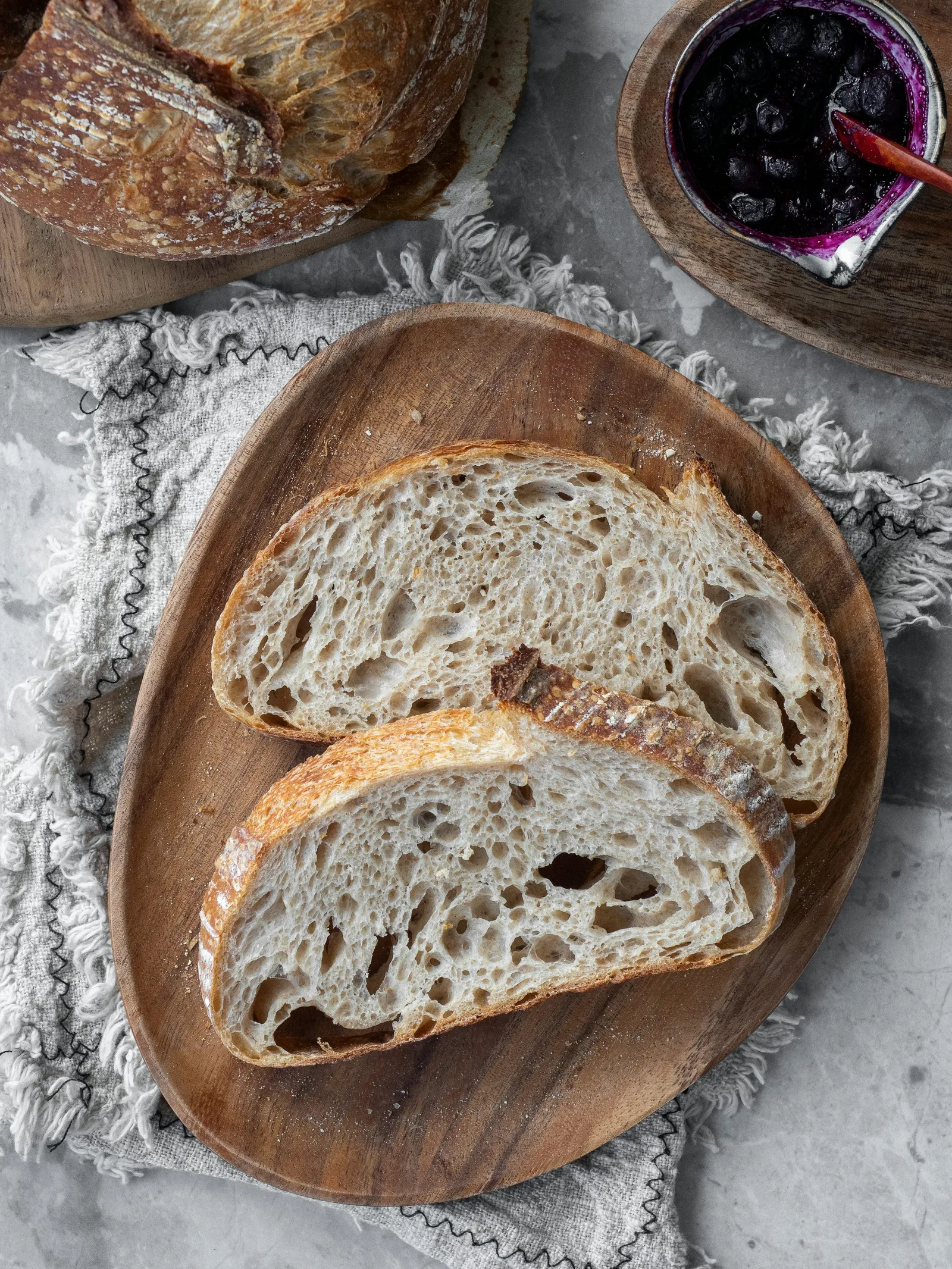
An autolyse rests flour and water before starter and salt; a fermentolyse includes starter, so fermentation is already underway. Follow the recipe’s ingredient sequence, include all reserved water in the formula, and use a rest to solve a specific handling problem.
- Read which ingredients are present; recipe terminology varies.
- Count fermentation from starter incorporation, even if a later timer is labeled bulk.
- Keep starter water and holdback water inside the original formula totals.
- Longer rests are not automatically better, especially with unfamiliar flours.
Choose the rest by what it contains
An autolyse, in the strict sense used here, rests flour and water before the starter and salt are incorporated. A fermentolyse includes the starter during that rest and generally delays the salt. The practical distinction is fermentation: once an active starter is mixed in, that mixture has already entered its fermentation history. Neither name tells you whether a dough is ready for shaping, how much mixing it needs, or when the bread will be baked.
Recipe vocabulary is not completely uniform. King Arthur's sourdough baking guide, for example, calls a rest containing starter an autolyse. Read the ingredient sequence instead of changing a recipe to make its heading match a definition. On a working recipe, replace an ambiguous instruction with a plain note such as 'flour and water only' or 'starter included; salt still to add.' That one line prevents several timing and ingredient mistakes later.
Identify the problem before adding a stage
A rest can be useful when flour is slow to take up water or when the dough is difficult to extend during mixing. It is less useful as a ritual added to every recipe. King Arthur and The Perfect Loaf describe hydration and changes in dough extensibility as reasons to use an autolyse. Those are observable handling goals. An attractive crumb photograph alone does not show that the rest caused the result, because mixing, fermentation, shaping, and baking also matter.
Write a question you can answer during the next batch: does the rested mixture become easier to combine, does it need less active mixing, or does adding the starter become awkward? Choose one of these questions rather than expecting simultaneous improvements in flavor, volume, scoring, and schedule. A method that saves mixing but adds an inconvenient second mixing session may still be a poor fit for your kitchen. Convenience is a legitimate part of the comparison.
Keep the ingredient ledger intact
Consider an illustrative dough with 600 g total flour, 420 g total water, and 12 g salt. Its hydration is 70%, and its salt is 2% of total flour. If it uses 120 g of starter at 100% hydration, the starter supplies 60 g flour and 60 g water. The fresh additions are therefore 540 g flour and 360 g water. These numbers describe a formula, not a tested bread recipe or a recommended rest duration.
Suppose you reserve 30 g of the fresh water for the final mix. A flour-and-water autolyse then contains 540 g flour and 330 g water, approximately 61.1% hydration at that stage. Add the starter, the reserved 30 g water, and the 12 g salt later. Final totals remain 600 g flour and 420 g water. Pouring in an extra unmeasured splash to dissolve the salt would change the formula; reserved water belongs inside the original total.
| Stage | Flour represented | Water represented | Salt represented |
|---|---|---|---|
| Flour-and-water rest | 540 g | 330 g | 0 g |
| Starter contribution | 60 g | 60 g | 0 g |
| Reserved additions | 0 g | 30 g | 12 g |
| Finished dough total | 600 g | 420 g | 12 g |
Understand why the two mixtures feel different
With the same ledger, a fermentolyse contains the 540 g fresh flour, 330 g initial water, and 120 g starter. It therefore already contains all 600 g flour and 390 g water: 65% hydration before the reserved water arrives. Comparing its softness with the flour-only version is not a clean test of fermentation alone. The two bowls have different temporary hydration and different ingredients, even though their finished formulas will be identical.
This distinction is especially useful when copying a stiff dough recipe. Removing a liquid starter from its initial mixture may make the remaining flour and water unexpectedly dry. Do the subtraction before mixing, and check whether the original author intended that situation. Do not keep adding water until the bowl resembles someone else's video. If a particular mixing sequence requires water carried in the starter, follow that complete sequence and record it accurately.
Mix the resting portion thoroughly enough
For a flour-and-water rest, combine the ingredients until no isolated dry flour remains. Scrape the bottom and corners of the bowl, where a damp surface can hide dry pockets. Cover the mixture so its surface does not dry while it rests. It need not look like finished, fully developed dough before the pause. The immediate objective is even contact between the planned flour and water, not an impressive windowpane or a perfectly smooth ball.
An efficient setup separates ingredients into three clearly labeled groups: the portion mixed now, the ingredients added later, and any optional ingredients the recipe introduces during another stage. Put the weighed salt beside the covered bowl instead of returning its container to the cupboard. If interrupted, mark which additions are complete. A forgotten 12 g of salt is a larger practical failure than choosing one respectable name for the rest over another.
Add the remaining ingredients deliberately
After the rest, incorporate the starter, salt, and reserved water according to the recipe's mixing method. The Perfect Loaf notes that later additions can be more difficult to work into a mixture that has already developed structure. Use that information to plan enough attention for this step. Look for uniformity rather than assuming that a specified number of squeezes guarantees it. Distinct streaks, dry salt patches, or pieces of stiff starter mean the mixture is not yet even.
If the dough begins to tear during incorporation, stop escalating the force. Check whether a brief covered rest and smaller additions fit the method, then resume gently. Breadtopia specifically discusses gentle incorporation and rests when the mixture tears. Record any extra water you actually add. A mixing difficulty and a hydration decision are different problems; solving both at once without a record leaves you unable to explain the finished dough's composition.
Put fermentation on the correct timeline
Imagine two hypothetical schedules. In schedule A, flour and water are mixed at 09:00, and starter is added at 09:40. In schedule B, starter is included at 09:00, with salt added at 09:40. At 10:00, A has had starter present for 20 minutes and B for 60 minutes. The arithmetic does not predict their relative rise, but it shows why calling both 'twenty minutes into bulk' can conceal an important difference.
Keep the original inoculation timestamp even if your recipe starts its bulk timer after final mixing. You can maintain two labels: 'starter incorporated' and 'final mixing finished.' This makes a fermentolyse compatible with clear recordkeeping without pretending fermentation switched on at the later label. When comparing schedules, also record actual dough temperature. An additional warm interval and an additional cool interval are not interchangeable blocks that can simply be subtracted from a clock.
Select duration without turning it into a contest
A longer rest is not automatically a better rest. The Perfect Loaf suggests conservative, short trials when developing a method, while published recipes use different lengths for different flours. Begin with a complete recipe's stated interval and inspect the handling change it was intended to create. If that recipe already works, there is little reason to add hours solely because another baker uses a long autolyse with a different flour blend.
For a controlled comparison, keep the rest temperature, flour batch, water total, and mixing approach consistent. Change only one duration at a time, and note both the planned and actual intervals. If the second dough also sits in a warmer room, the result belongs to a combined change. You can still learn whether that workflow suits you, but you cannot isolate the effect of duration. This is a useful limit, not a reason to abandon practical home comparisons.
Match the method to the flour
The wheat-dough handling arguments in this guide should not be applied indiscriminately to high-rye, gluten-free, sprouted-grain, or unusually weak-flour formulas. Breadtopia describes circumstances in which an extended rest is unhelpful or the mixture deteriorates, and King Arthur cautions against applying its autolyse approach to sourdough rye. Those cautions are reasons to use a flour-specific method, not reasons to invent a single percentage at which every dough suddenly changes category.
Read the flour description as carefully as the hydration number. 'Whole grain' does not identify the grain, milling, age, or blend. If replacing part of a familiar bread flour, make that substitution the experiment for the day and preserve the recipe's other stages. Altering flour, hydration, rest duration, and mixing intensity together may produce edible bread, but it gives little guidance about which choice should be repeated when the next bag of flour arrives.
Diagnose the immediate problem
If flour remains dry, first verify the weighed quantities and scrape through the mixture; time alone cannot fix an ingredient omitted from the bowl. If the mixture was uniform but becomes difficult to handle, compare its condition before and after the rest. If it is easier to stretch but harder to organize, the result may simply be a change in handling rather than proof that the rest failed. Choose the next action based on the observed problem.
If the main difficulty is repeatedly forgetting late ingredients, shorten the workflow instead of perfecting a complicated reminder system. A recipe that mixes everything together and then rests can be a sensible alternative, although it is not the same experiment. If incorporation is consistently laborious, consult a method designed around your mixing equipment. The useful endpoint is a repeatable process that produces evenly mixed dough, not loyalty to a particular technique label.
| Observed issue | First check | Avoid assuming |
|---|---|---|
| Dry pockets | Weights and complete initial mixing | A longer rest will add missing water |
| Tearing during incorporation | Force, additions, and whether a rest is needed | More force always develops more strength |
| Unexpected early activity | When starter actually entered the dough | Fermentation starts only after salt |
| Forgotten ingredients | A visible additions checklist | A more complex workflow is better |
Run a comparison that answers a real question
For a first comparison, use the same familiar formula on two separate baking days, one following its normal method and one using a clearly documented rest change. This is easier to manage than two bowls competing for your attention. Record active mixing minutes, difficulty of incorporating the late additions, dough temperature after mixing, and shaping behavior. Keep baked-loaf observations secondary until you have established whether the proposed handling benefit actually appeared.
A simple result might be 'the rest reduced active mixing, but adding the stiff starter took longer.' That supports a workflow decision without claiming a universal loaf improvement. Another valid result is 'no clear difference.' If you later run a paired batch, do not compare freshly mixed warm flour with a bowl that has cooled for hours and attribute everything to autolysis. State the temperature difference and repeat only if the question still matters to your baking.
Choose a workable default
Follow a complete recipe's sequence for the first bake, including which ingredients rest together. Use a separate autolyse when it solves an identified mixing or handling problem and fits your schedule. Use a starter-inclusive rest when the recipe is designed around it, while recording the earlier fermentation start. Neither approach removes the need to incorporate salt, account for water, or observe the dough through the remaining process.
Keep a short method card with four entries: resting ingredients, reserved additions, start and end time, and the change you noticed. Add one sentence about whether the extra step was worthwhile. That card gives you something concrete to compare next time, without turning every loaf into a research project. Once the quantities and sequence are explicit, unfamiliar terminology becomes much less intimidating and far less likely to hide a practical mistake.
Sources & further reading
This guide combines published references with our own explanations and decision aids. Numerical examples are illustrative; they are not records of Sourdough Bench test bakes.
Put it into practice.
Keep the recipe, observations and next change together in your downloadable bake log. For a symptom-led starting point, use the loaf troubleshooting guide.