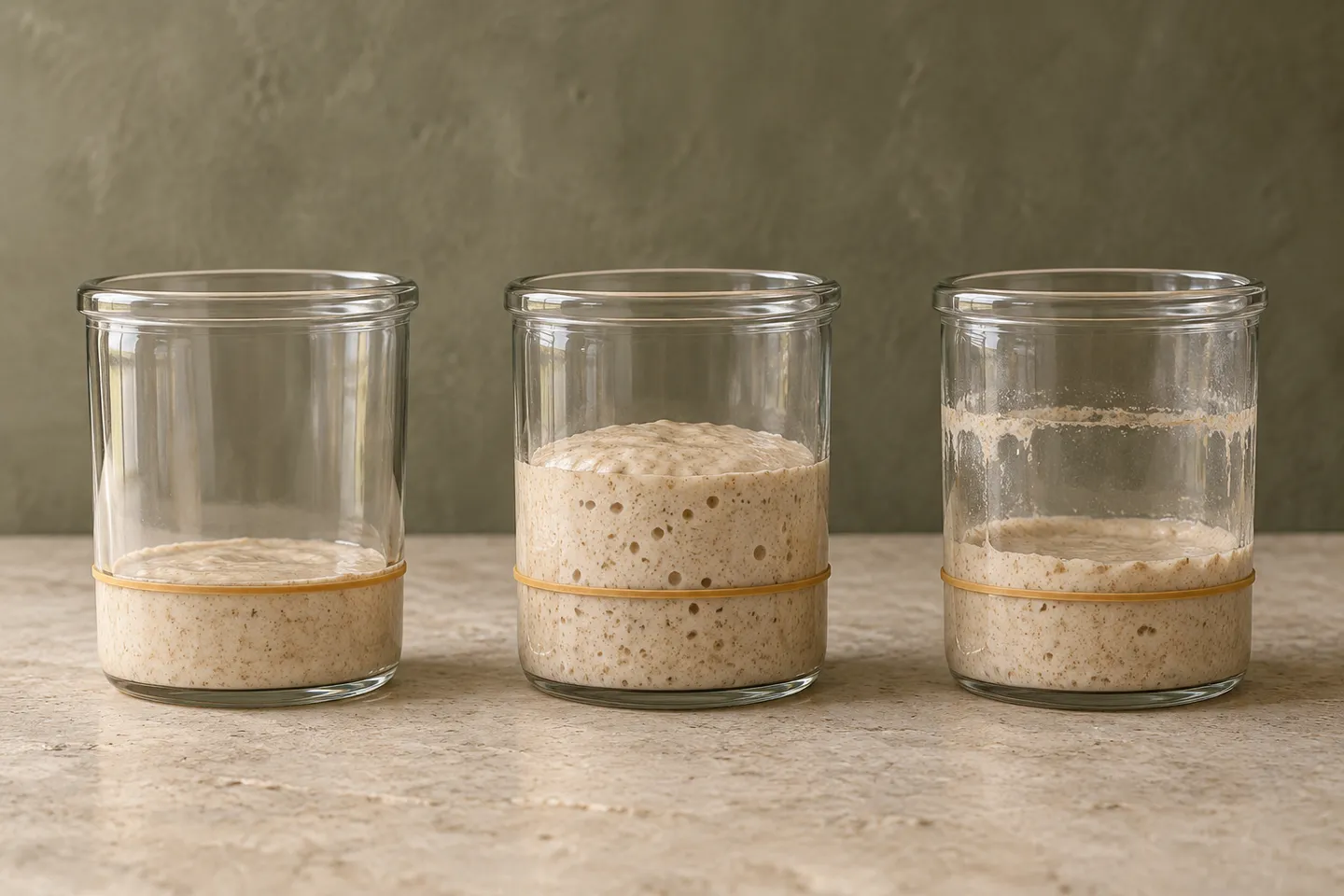
Match what you see to the next check
Use the table for a starter with no visible mold or unusual pink discoloration. If you see either, follow the discard guidance below. The other rows suggest observations and adjustments, not a diagnosis from appearance alone.
| What you see | What to check next | What to compare |
|---|---|---|
| A new starter rose early, then went quiet | Continue a consistent starter-building method; record its age and temperature. | Look for a repeatable rise across later feeds, not a day-number deadline. |
| A mature starter is slower in a cold spot | Measure temperature near the jar; use a consistently moderate location. | Compare the next cycle with a feed at the same ratio and flour. |
| Bubbles, but little height | Check gram weights, seed hydration and whether the mixture is very thin. | Observe gas and expansion together after a documented feed. |
| A low starter with a higher mark on the jar | Check whether it rose and fell while unattended. | Mark the fresh level and look earlier in the next cycle. |
| Weak activity after refrigeration | Follow a revival routine for an established starter. | Watch successive feeds for returning, predictable activity. |
Record six things before changing the feed
A short note makes the next decision easier. Use actual weights and measurements where possible; write 'unknown' rather than guessing a missing detail.
| Record | What to write |
|---|---|
| Starter history | Days since mixing, or when an established starter last rose reliably |
| Feed | Seed starter / fresh flour / fresh water in grams |
| Flour and hydration | Flour type, any recent change, and known seed hydration |
| Temperature | Measured temperature near the jar; note if the location changed |
| Time | Feed time and each observation time |
| Rise | Starting mark, highest observed level, bubbles and any fall |
A new starter can have a quiet phase
An early burst of bubbles or expansion does not establish a mature culture. King Arthur describes new starters that rise initially, then become quiet while they develop. A pause alone is not a reason to restart.
Continue the measured feeding routine in your starter-building method and keep the conditions consistent. Avoid changing flour, ratio and temperature all at once, or repeatedly diluting the mixture because a few hours have passed. The useful endpoint is predictable activity after feeding, not reaching day six or seven.
Bubbles without height: check consistency
Bubbles show visible activity, but a very thin starter may let gas escape instead of holding enough to rise. First check whether you weighed flour and water. Equal volumes are not equal weights.
Also check for a flour change: the same flour-to-water weight ratio can produce a different consistency with another flour. Return to a documented feeding method so your height comparisons mean something. If you deliberately add more flour, record the amount and update the hydration; do not keep calling the altered build the same formula.
A slow mature starter needs its history checked
For a starter that previously rose reliably, look for what changed: a colder position, a different flour, a larger feed or time in the refrigerator. Each can change what you observe. Keep the jar in a consistently moderate place rather than using intense heat as a shortcut.
A starter returning from storage may need repeated feeds before its familiar behavior returns. Judge it through those cycles. Do not assume that bubbles immediately after one feed mean it will raise a loaf on your usual schedule.
Watch one complete feeding cycle
Use a clean, straight-sided jar with enough room for expansion. Mark the level just after feeding. Note the highest level you actually observe and any later fall; a late glance at a low starter can miss the rise entirely.
Repeat under the same measured conditions. A recurring rise, aerated texture and recognizable rise-and-fall pattern give more useful evidence than a single photograph. A float test is not a substitute: King Arthur's test found that starter could float before it was ready.
When to discard and start again
Discard a starter with visible mold or unusual pink discoloration, clean the container and start again. Do not scrape off the affected layer and keep feeding what is underneath.
A quiet starter, an acidic aroma or a layer of liquid is a different observation from visible mold. Those signs need the feeding history and other checks above; they do not make every discolored or questionable starter safe to rescue.
Sources & further reading
This guide combines published references with our own explanations and decision aids. Numerical examples are illustrative; they are not records of Sourdough Bench test bakes.
Put it into practice.
Keep the recipe, observations and next change together in your downloadable bake log. For a symptom-led starting point, use the loaf troubleshooting guide.